 Add to Chrome
 Add to Firefox
 Add to Edge
ORBIS: Output-Guided Token Reduction with Distribution-Aware Matching for Video Diffusion Acceleration
May 21, 2026
Diffusion Transformer (DiT) has emerged as a powerful model architecture for generating high-quality images and videos. In the case of video DiT, 3D Spatio-Temporal Attention increases token length in proportion to the number of frames, sharply increasing computational cost. Token reduction methods mitigate this cost by exploiting spatial redundancy, but existing approaches rely on inaccurate similarity estimates and lightweight matching algorithms, resulting in poor matching quality and only marginal acceleration. To overcome these limitations, we propose ORBIS, an SW-HW co-designed accelerator for video DiT. ORBIS leverages the output activation from the previous timestep to obtain more accurate inter-token similarity, substantially improving matching quality and enabling a higher token reduction ratio. We further introduce a Distribution-Aware Token Matching (DATM) algorithm that captures global token distribution and explicitly minimizes token-pair loss for additional gains. To fully hide DATM latency, we design specialized, deeply pipelined hardware and minimize its hardware cost through quantization, occupying only 2.4% of total area with negligible accuracy loss. Extensive experiments show that ORBIS achieves about 2x higher token reduction ratio than the state-of-the-art approach, AsymRnR, while delivering up to 4.5x speedup and 79.3% energy reduction compared to an NVIDIA A100 GPU.

Rethinking Token Reduction for Diffusion Models via Output-Similarity-Awareness
May 21, 2026Diffusion Transformers (DiTs) achieve superior image generation quality but suffer from quadratic computational complexity relative to token count. While various token reduction (TR) methods have been proposed to mitigate this cost, they overlook the primary objective of generative models: minimizing recovery error, which requires reflecting output token similarity. They rely solely on input token similarity inherited from reduction-only ViT paradigms, leading to a fundamental misalignment with this objective. To bridge this gap, we propose DiTo, a novel TR paradigm that shifts the focus toward output-centric token reduction. Based on the observation that output token similarity is consistently preserved across adjacent timesteps, DiTo utilizes prior-step similarities as an effective proxy to establish token correspondences at a Matching timestep, which are then reused across multiple subsequent Reduction timesteps. To optimize this interleaved scheduling, we propose Pair Match Ratio (PMR)-guided Interval Scheduling to determine the optimal matching frequency. Furthermore, to mitigate localized approximation errors and resulting blocking artifacts caused by repeated reuse, we propose Frequency-aware Token Matching by incorporating a selection-frequency penalty. Extensive experiments demonstrate that DiTo consistently outperforms existing TR methods with 1.6-3.9 dB higher PSNR at comparable speedups, achieving a superior Pareto frontier.
EXION: Exploiting Inter- and Intra-Iteration Output Sparsity for Diffusion Models
Jan 10, 2025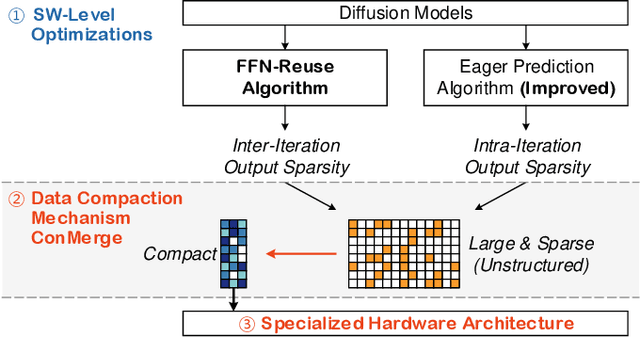
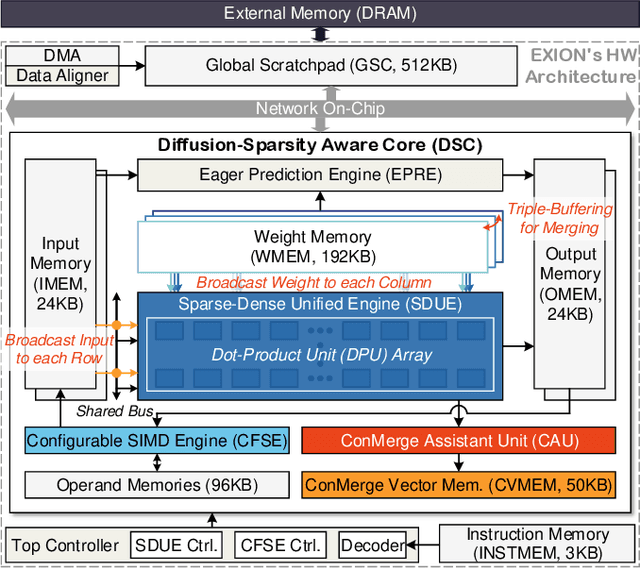
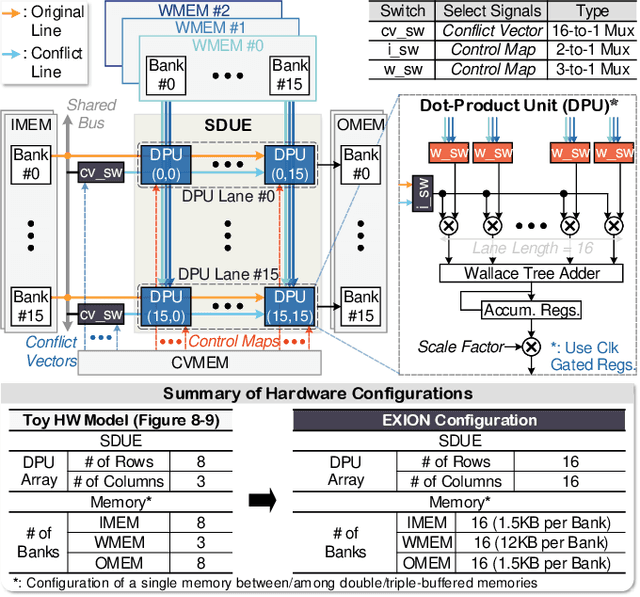
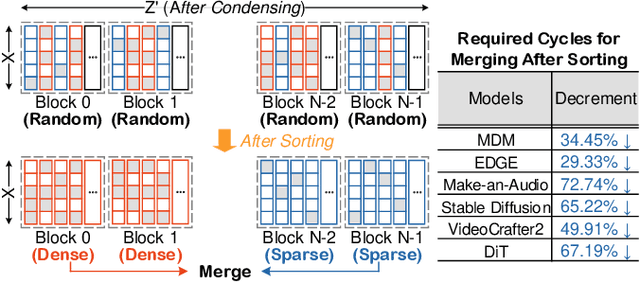
Over the past few years, diffusion models have emerged as novel AI solutions, generating diverse multi-modal outputs from text prompts. Despite their capabilities, they face challenges in computing, such as excessive latency and energy consumption due to their iterative architecture. Although prior works specialized in transformer acceleration can be applied, the iterative nature of diffusion models remains unresolved. In this paper, we present EXION, the first SW-HW co-designed diffusion accelerator that solves the computation challenges by exploiting the unique inter- and intra-iteration output sparsity in diffusion models. To this end, we propose two SW-level optimizations. First, we introduce the FFN-Reuse algorithm that identifies and skips redundant computations in FFN layers across different iterations (inter-iteration sparsity). Second, we use a modified eager prediction method that employs two-step leading-one detection to accurately predict the attention score, skipping unnecessary computations within an iteration (intra-iteration sparsity). We also introduce a novel data compaction mechanism named ConMerge, which can enhance HW utilization by condensing and merging sparse matrices into compact forms. Finally, it has a dedicated HW architecture that supports the above sparsity-inducing algorithms, translating high output sparsity into improved energy efficiency and performance. To verify the feasibility of the EXION, we first demonstrate that it has no impact on accuracy in various types of multi-modal diffusion models. We then instantiate EXION in both server- and edge-level settings and compare its performance against GPUs with similar specifications. Our evaluation shows that EXION achieves dramatic improvements in performance and energy efficiency by 3.2-379.3x and 45.1-3067.6x compared to a server GPU and by 42.6-1090.9x and 196.9-4668.2x compared to an edge GPU.